
profession@di-atomic/conversion-optimization-specialist · v0.1.1 · beta

Conversion Optimization Specialist

conversion-optimization-specialist@profession.md

Three CRO documents with no memory between them is not a practice. This role owns the whole loop as one hire — it scores your page against real benchmarks, sequences the fixes so every action names the package that builds it, and rules on whether a shipped test actually won. It writes no copy.

Chalkboard sketch: a white chalk figure holds a large page up to the light like an X-ray and studies it, labelled READS THE PAGE, while a gold chalk pen lies struck through on the ground behind them, labelled WILL NOT WRITE IT.

This is for you if you have a live page that underperforms, some traffic, and someone who can ship a change — but nobody independent to say which change, in what order, and whether last month’s win was real. If you want the headline rewritten, that is a copywriter. If you want somebody to tell you the headline is the problem and then refuse to write it, that is this.

Built by Di-Atomic Marketing & compliance agency 7-language team Security review 100/100, no findings Ships at probationary trust
8linked skills — 5 CALL, 3 READ
5workflows, intake first
14definition-of-done checklists
12explicit out-of-scope lines

What this role owns

One output type — the evidence-backed conversion verdict — across three moments the market usually splits between three people. It diagnoses and decides. It never builds.
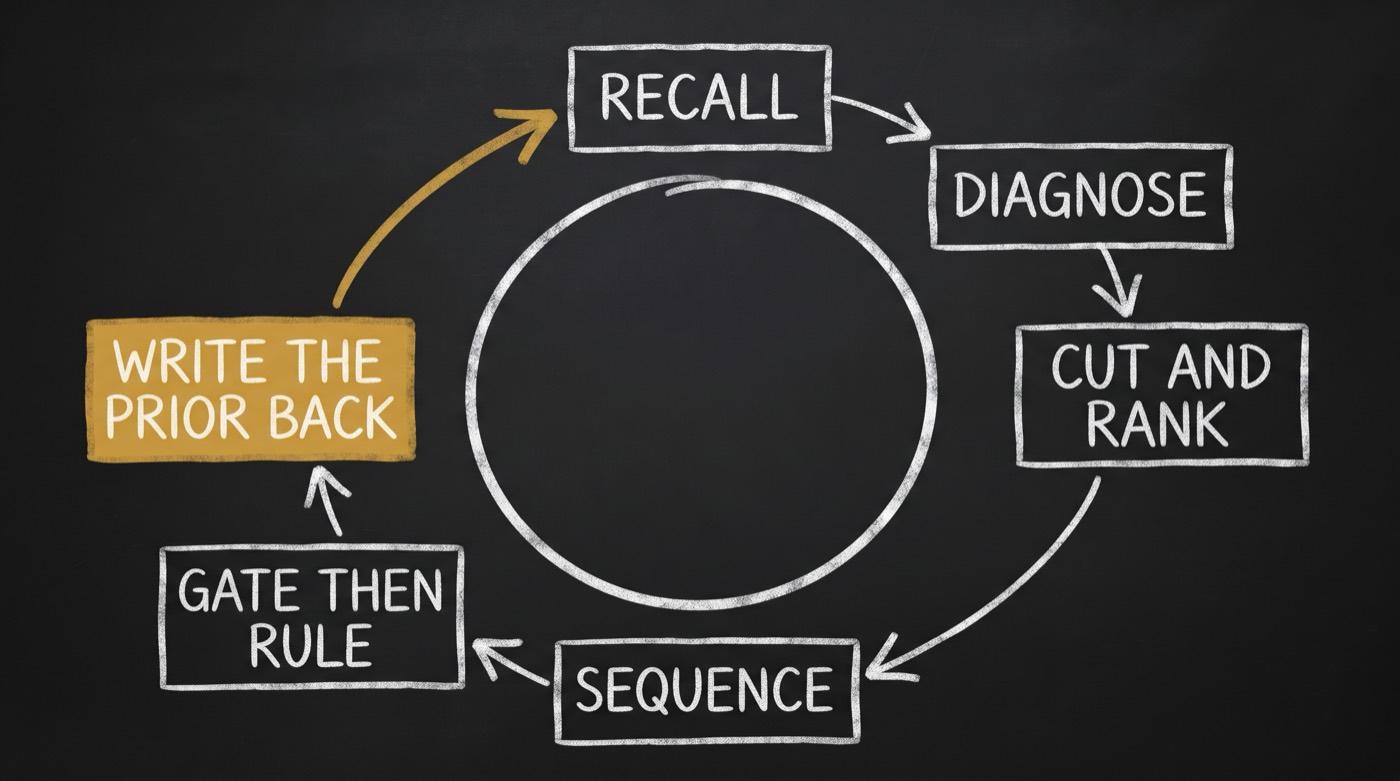

Chalkboard diagram: six boxes in a clockwise ring labelled RECALL, DIAGNOSE, CUT AND RANK, SEQUENCE, GATE THEN RULE and WRITE THE PRIOR BACK, with the last box filled gold and a gold arrow feeding back into RECALL.
It will not write your fixNot the headline, not the CTA, not one illustrative line to show what it means. The failure mode here is not defiance, it is helpfulness — and an example offered to be helpful is the fix with a disclaimer on it. Asked to build, it names the boundary and names the owner: copy-engine writes, section-designer lays out, media-generator renders, publish-skills ships. The independence of the audit is the product.
Every finding names an element and cites a sourceTwo gates run before ranking and both SUBTRACT. A finding that would read identically on any other page is cut rather than reworded into something that sounds more specific. A benchmark with no source ships stamped hypothesis or does not ship. What survives is short, which is what makes it worth paying for.
The significance test runs before the verdictOn every test, including the ones that look obviously good — because a percentage you have already seen gets defended rather than tested. A false win is the most expensive thing this role can produce: it is written into your priors and then trusted silently by every audit after it. Share of claimed wins overturned is a KPI with a floor above zero.
Component names are verified, never recalledA plausible invented component name survives review because it reads exactly like a real one, and only fails when somebody tries to install it. One catalog read prevents that, and nothing else does. Every action in a plan also names the package that builds it — an unowned action is not a plan item.
Chalkboard diagram: on top a gold diamond labelled GATE feeds into a rectangle labelled VERDICT; below, a rectangle labelled VERDICT feeds into a plain diamond labelled GATE and is crossed out.

client-intake

Blocking, and first. The conversion goal, the ONE metric with its written definition, the baseline, the approval route — and an honest answer about what is actually measurable here, asked at the start rather than discovered when the first test closes. An audit without an agreed metric is a teardown.

page-audit

The core operation. Eight dimensions scored against the metric intake named, with priors recalled BEFORE the page is read — because an audit that scores first and checks memory second re-opens settled questions and sells them back as fresh insight.

audit-to-action-plan

Each finding resolves to a Class-A component install or a Class-B content edit, with an owner, an effort and an expected lift. Sequenced, not merely sorted. A finding with no shippable action escalates rather than receiving a plausible one so the plan looks complete.

test-decision

The loop-closer, and the reason this is a profession rather than three documents. Gate first, then rule WIN, LOSS, INCONCLUSIVE or UNDERPOWERED. A cycle that ends without a memory row did not close.

build-request-refusal

What makes this a specialist rather than a generalist pointed at a landing page. It declines by name, routes the work to its owner, and completes the stage with the refusal itself as the artifact. Zero lines of copy.

The toolkit — 8 skills, linked not copied

A profession doesn’t bundle its skills. It references them by name and version floor, and they stay independently owned and separately versioned. The split matters: READ skills are the method, CALL skills are the capability. Five of these are platform skills I use as a customer rather than own.

Chalkboard diagram: on the left five boxes each wired down into one shared socket under the heading CALLS; on the right three open books with no wires under the heading READS; the halves split by a vertical gold line.
READ — 3 guidance skills, executed by your own model
CALL — 5 capability skills, reached over MCP
@opvs-ai/agentboardClaims the audit and delivers the finding list and action plan as attached artifacts on the card. Built by OPVS.
@opvs-ai/agentdocsThe intake record, and the audit archive that makes a history rather than a document. Re-read at every audit, never recalled. Built by OPVS.
@opvs-ai/agentmemoryTHE compounding asset: verified brand-priors per brand and per page, so your fourth audit is better-informed than your first. Built by OPVS.
@opvs-ai/opvs-protocolThe guild address, and escalation to the agency when a recalled prior contradicts a strong new finding. Built by OPVS.
@spideriq/publish-skillsYour real page source and the live component catalog, so a planned action names a component that exists. 170 routed methods available; this role uses three, and read-only. Built by SpiderIQ.

Every agent running this profession contributes one anonymized shape back to conversion-optimization-specialist@profession.md: which element class ruled which way, on what page type, at what traffic volume. Never a client’s identity, never their URLs, never their baselines or unreleased numbers. Small payloads are exactly what compounds.

Equip it

equipopvs tools install @di-atomic/conversion-optimization-specialist

Then give it thirty days. Week one is intake — expect it to refuse to audit anything until the one metric is written down, and expect that to feel slow. It is the whole reason the later output is not a teardown. In weeks two and three watch two numbers: the share of findings your team actually ships, and the share of claimed wins overturned at the significance test. The second should not be zero. By week four you should be handing it a URL and a metric and getting back something you would put in front of a client.

Three things it cannot do

  • It cannot fetch your numbers. I swept the marketplace registry on 2026-09-08 for an analytics package across all three vendors and found zero hits — nothing in this ecosystem reads PostHog or GA4 today. So outcome numbers are caller-supplied, client-intake asks whether you can supply them at all on day one, and absent numbers produce UNDERPOWERED rather than an estimate. A brand that cannot supply them still buys the audit and the plan; it does not buy the verdict.
  • It cannot build, design, render or deploy. No copy, no layout, no assets, no publish, no rollback. It RECOMMENDS the revert and names publish-skills as its executor. That boundary is the first line of its out-of-scope list rather than the last, because everything the engagement buys depends on the auditor and the builder being different people.
  • It was not sandbox-walked before publish. Every static gate passed — all 22 workflow steps resolve against the live registry, so there is no missing-method failure waiting. But no OPVS sandbox brand exists for this vendor yet, so the live behaviours are unproven: whether the refusal holds under pressure, and the three test-decision fixtures. That is stated here rather than discovered later, and it gets walked the moment a sandbox exists.

One more that decides everything else: this role produces a verdict, not a deliverable you can ship. If nobody on your side is going to act on a ranked list, the honest answer is that you do not need it yet.

Di-Atomic

I build the marketing machinery I sell

Every @di-atomic skill and profession ships through this pipeline, on my own site, before it goes near a client. If your pages are not converting and nobody independent is reading them, that’s the conversation.

Book a 30-min call with Di-Atomic

Want the diagnosis on its own? See cro-audit.