
Audio-ducking check passes a video with no ducking at all, Di-Atomic test finds
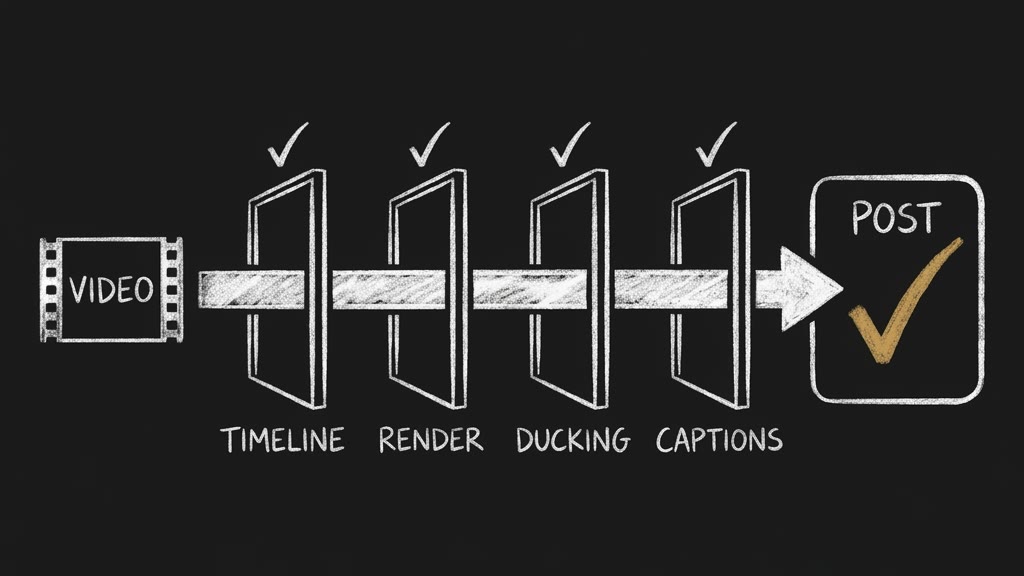
Di-Atomic publishes @di-atomic/video-editor, a video skill for AI agents whose four gates read the finished file instead of the render settings
WILMINGTON, Del., September 24, 2026
WILMINGTON, Del., September 24, 2026 — Di-Atomic today published @di-atomic/video-editor, a skill that lets an AI agent assemble a shot list and its finished clips, voiceover and music into one video, together with the measurements behind its checks. A check that compares loudness during speech with loudness in the pauses, used to confirm that background music ducks under a voice, passed a render with no ducking at all, reading a 9.96 dB gap. [source: https://di-atomic.com/blog/shipping-di-atomic-video-editor]
Because the voice is part of the mix, the mix is louder during speech whether or not the music moved. Di-Atomic measured five ducking methods on the same voiceover: no ducking, the first sidechain-compressor recipe returned by a web search, ffmpeg's compressor defaults, whole-mix normalisation, and a speech-driven envelope at -12 dB. The mix-level gap read between 9.48 and 9.99 dB for all five. [source: https://di-atomic.com/blog/shipping-di-atomic-video-editor]
The skill's ducking gate instead estimates the music's own share of the finished file, solving each 50-millisecond window against the voice and music tracks that went in. On the four methods where the exact answer was known, the estimate matched it to within 0.01 dB. The gate also measures pumping: the sidechain recipe cut the music by 17.77 dB but let it rise 6.37 dB between words. [source: https://di-atomic.com/blog/shipping-di-atomic-video-editor]
"I trusted that check until I ran it on a video with no ducking and it still passed," said Martin Shein, founder of Di-Atomic. "So every gate in this skill reads the finished file, not the settings, and each one has a control built to fail it."
The same approach runs through three further gates. A timeline gate runs before render and refuses three planning mistakes that ffmpeg renders with exit code 0, including a voiceover whose last six words fell past the final frame. A caption gate compares the same frame with and without captions, after a two-timestamp test passed a video with no captions at all. A render gate checks codec, duration, black and frozen runs, loudness and true peak. [source: https://di-atomic.com/blog/shipping-di-atomic-video-editor]
The skill renders with local ffmpeg in Claude Code, Codex and Antigravity. On OPVS agents without ffmpeg it writes a job for SpiderVideo, the SpiderIQ cloud renderer, and lists every field that path cannot honour. Di-Atomic states the limits: zoom-out transitions are refused, the pumping measure is untested on percussive music, and the 46 control cases, run on macOS and Linux, used synthetic test media. [source: https://di-atomic.com/skills-video-editor]
@di-atomic/video-editor 0.1.1 is available free on the OPVS marketplace at beta tier and installs with opvs-skills install @di-atomic/video-editor. The method write-up is at https://di-atomic.com/blog/shipping-di-atomic-video-editor.
About Di-Atomic — standard (en)
Di-Atomic is a multilingual marketing and compliance agency for global distribution, founded by Martin Shein and operating as DEMAVIAS LLC. The agency works across seven languages with a team lead for each, and carries regulatory heritage in REACH, CLP, biocide product notification, safety data sheets and GHS classification. Di-Atomic is also a product company: agency revenue funds the development of SpiderIQ, OPVS and cognitoAI, the platforms the agency runs its own client work on. The skills Di-Atomic publishes to the OPVS marketplace are the same ones used to deliver client engagements.
Media contacts
For interviews, assets or further information.