
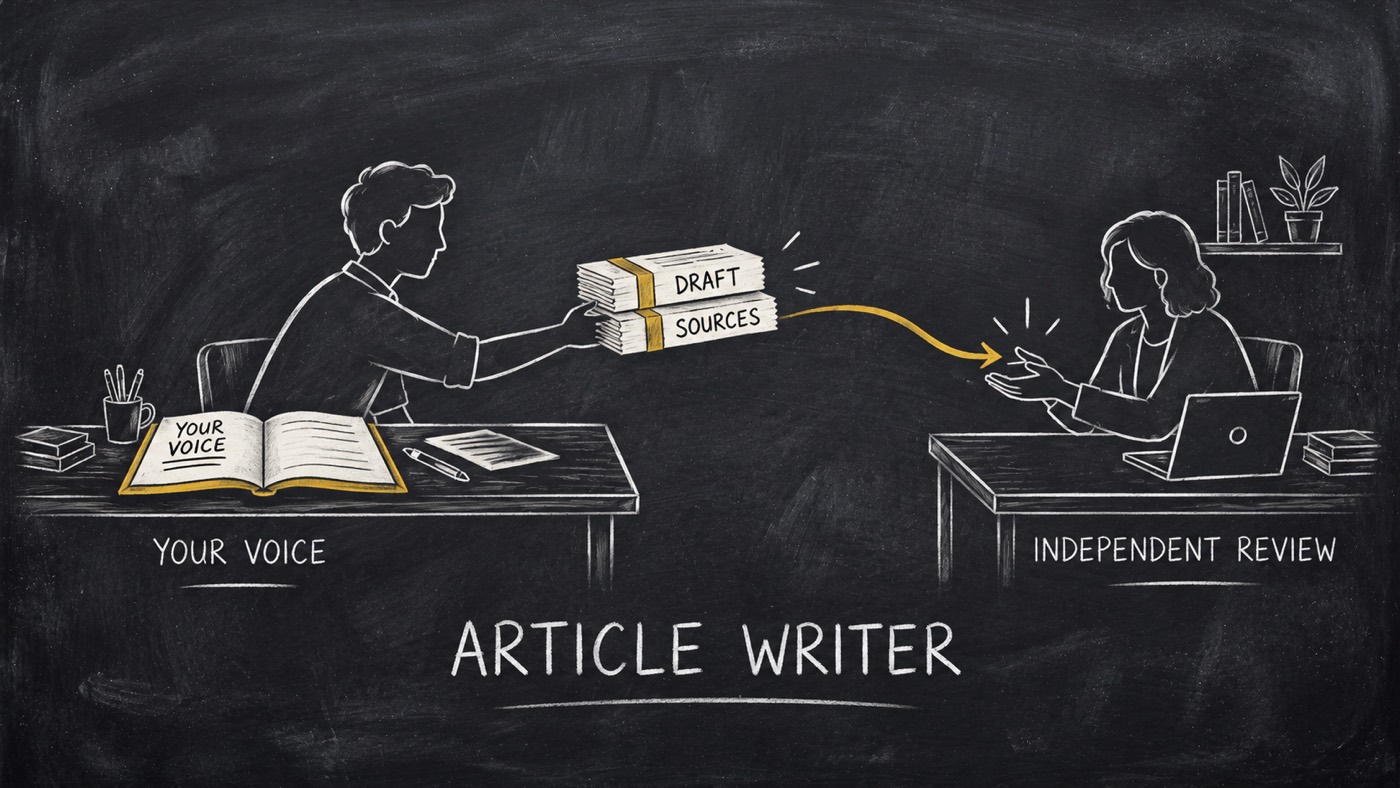
Hand over the article. Keep your voice.
I made Long-form Content Writer for the job between an approved brief and a draft that someone else can check.
You have a topic, a point of view and a voice. You still need someone to turn them into an article. Handing that job to an agent should not mean handing it permission to guess your numbers, change your tone or press Publish.
That is the job I gave Long-form Content Writer. It takes one article from a board card, reads the brief and your voice profile, and returns a draft with a sources file. The draft then goes to other checkers. It writes the piece. It does not give itself the final yes.
I have published the role as @di-atomic/article-writer 0.1.0, in beta. It covers blog posts, Substack issues, LinkedIn Articles and X Articles. Here is what you can hand over, what comes back, and where the role stops.
Give it a job with an edge
A useful brief names the reader, the article format and the question the piece will answer. It also points to the source material. “Write something about AI” leaves almost every choice open. “Explain this workflow to a marketing lead, using these sources and this voice profile” gives the writer a job it can finish.
The role claims its card before it starts. It reads the brief and the brand's voice.md from AgentDocs for that job. It does not treat an old memory of the voice as the current brief. If the voice profile is missing, the card is blocked. A generic article under your name is not the fallback.
You keep control of the voice. The writer uses it. Building or changing that profile belongs to the operator, with voice-builder when needed. That boundary matters most when the writer has a tempting line that sounds good but does not sound like you.
The board holds the handoff
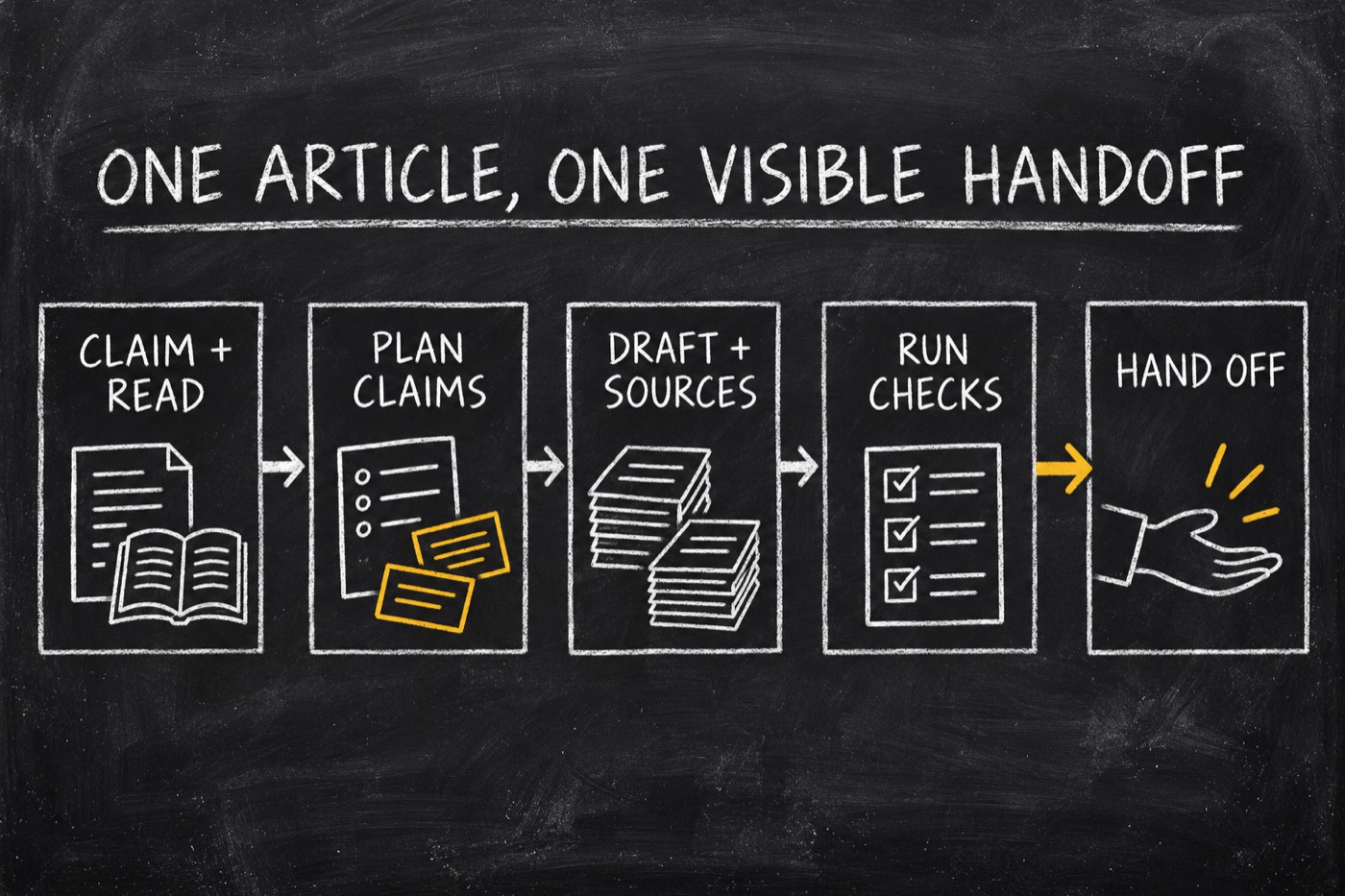
The work follows a visible path: claim and read, plan the claims, draft with sources, run the writing checks, then hand off. The card holds the result and the check output. The role completes its stage and moves the card to the next column named in the brief.
That makes a draft's place in the process visible. A draft handed to a Fact-Checking Analyst is waiting for a number audit. It is not ready to publish just because the writing pass ended. The board carries that distinction so you do not have to infer it from a chat message.
The role also handles rework. It reads the sources page and the checker's findings, then fixes the draft from those materials. A figure the checker struck stays struck. The next pass is a response to evidence, not another chance to sneak a stronger claim back in.
Every number needs a trail
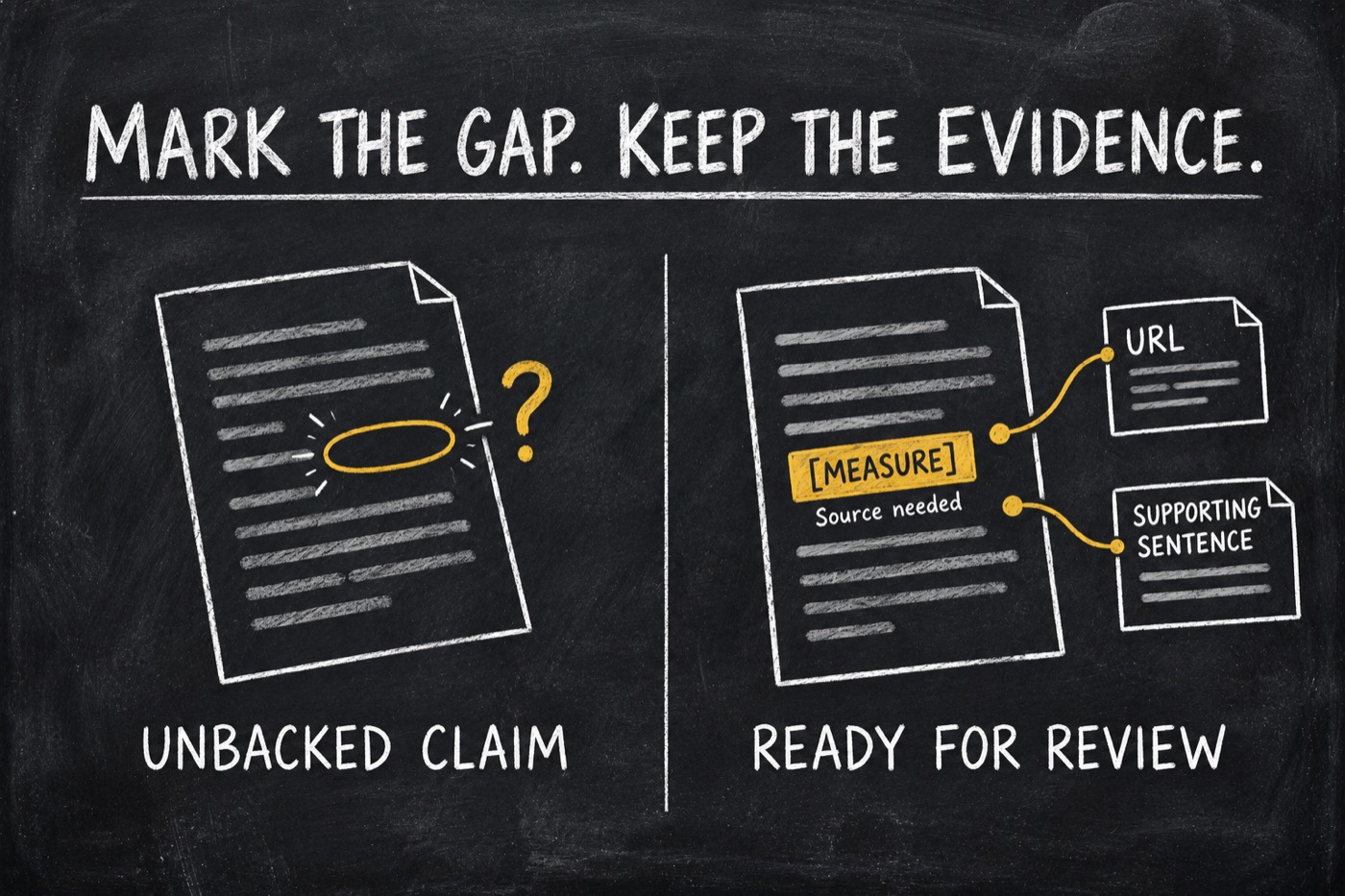
The sources file is part of the deliverable. A number in the draft needs its source URL and the exact sentence that supports it. Without that trail, the checker has to search for what the writer meant. With it, the checker can inspect the claim at its origin.
An unknown number becomes a marker such as [MEASURE: completion time, workflow run log]. That marker names what the Fact-Checking Analyst needs to measure. It is unfinished work made visible. It does not pretend that a plausible estimate is a measured result.
For example, a brief may say a process saves time without giving a measured duration. The writer can explain the process from the sources. It cannot turn that into a percentage saving. I would rather have a clear marker in a draft than a neat number that I cannot defend.
This rule also keeps the launch honest. I am describing the role's published contract here. I am not claiming a measured speed gain, a traffic lift or a customer result from using it.
Writing checks come before independent review
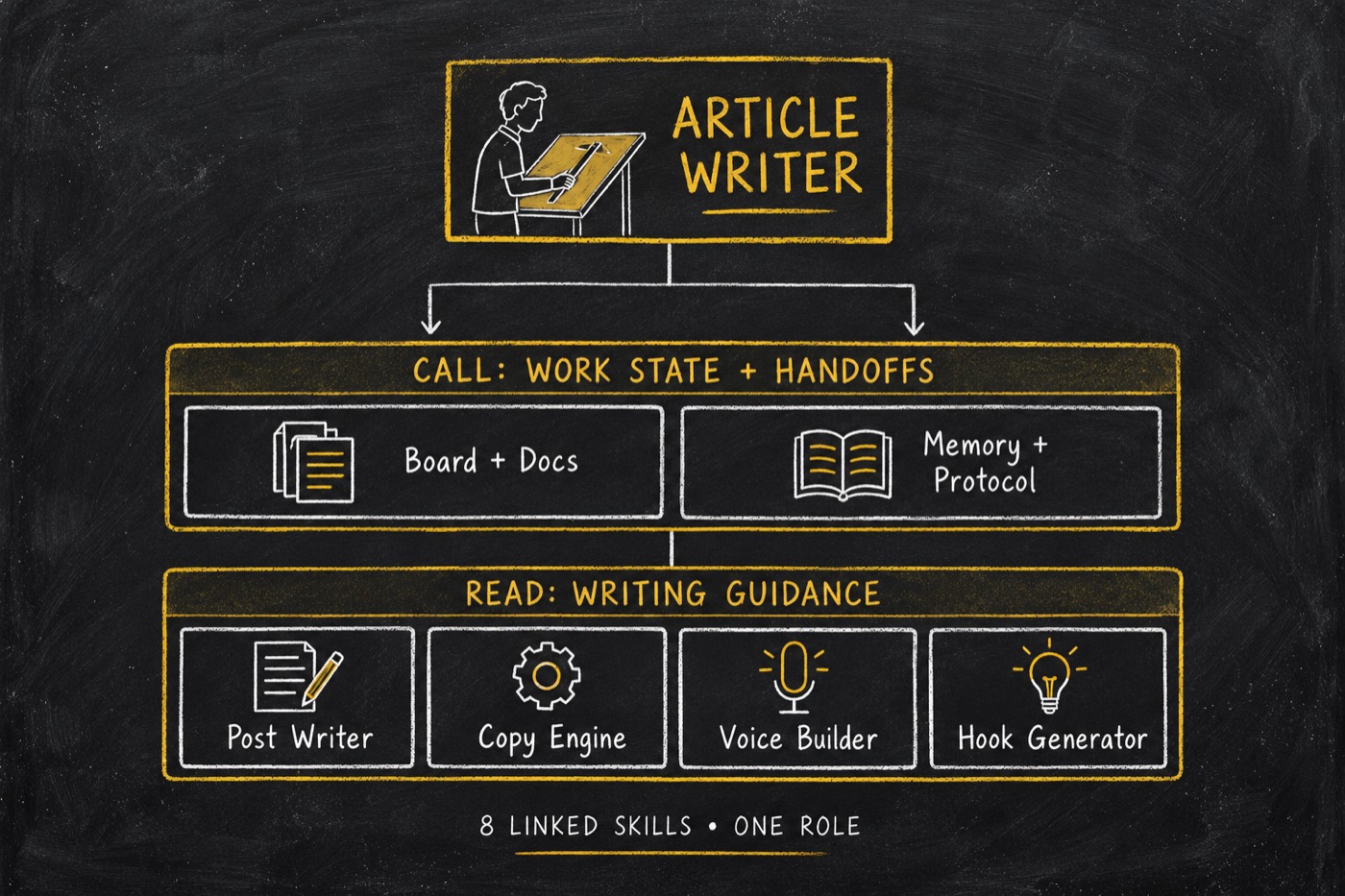
The writer reads the matching Article recipe from post-writer and uses copy-engine for the prose. It chooses the title and opening from at least three hook-generator options. The losing options stay on the card, so the choice has a visible basis.
It then runs the writing verifier scripts and posts their full output. A failed check is reported. Those checks help inspect the writing pass, but they do not turn the writer into its own Fact Checker or editor.
The draft goes on to the Fact-Checking Analyst, Fact Checker and editor on other models. That separation is in the role's limits. The model that wrote a sentence can miss the same weakness when asked to judge it. The writer's job ends with a handoff that gives the next checker enough material to work.
A toolkit with clear ownership
The profession links eight skills. It calls AgentBoard, AgentDocs, AgentMemory and OPVS Protocol for work state, documents, lessons and handoffs. It reads post-writer, copy-engine, voice-builder and hook-generator as guidance, then does the writing itself.
Its four workflows cover client intake, the board loop, an article draft and article rework. These are parts of one role. You hand it an article assignment rather than asking it to improvise a new set of responsibilities each time.
The limits are equally useful. Short social posts, threads and video scripts belong to the channel writers. The role does not publish or schedule. It does not rewrite your brand voice, invent a figure or review its own draft. Claims for regulated products remain subject to copy-engine's compliance rules.
Try a contained assignment
Start with one brief, an existing voice profile and source material you can inspect. Ask for the draft and the sources page. Name the next checker on the board before the writer starts. Then judge the handoff: can that checker trace the claims without reconstructing the writer's work?
You can find the Long-form Content Writer profession on this site and equip an agent with @di-atomic/article-writer from the OPVS marketplace. The role ships at probationary trust. Keep the review stages in place while you learn how it behaves on your briefs.
Hand over the article. Keep your voice, your evidence and the final decision.