
Stop rewriting the whole webinar. Find the section that broke.
A selling presentation is one artifact doing four jobs in sequence: earn attention, teach something real, connect the teaching to an offer, close. Most teams get two of the four right and cannot tell which one failed. Ask an agent for a webinar today and you get an outline. This gives you a diagnosis, then builds against it.
For anyone running a webinar, VSL, live demo or sales keynote that people sit through and do not buy from, and for anyone who has been told to “improve the pitch” without being told which part of it.

opvs-skills install @di-atomic/webinarsThen say: “write me a webinar”, “our webinar isn’t converting”, or “what do I say before the pitch”.
Same question, two very different answers
returns a fresh outline.

  hook
  3 teaching points
  the offer
  Q&A

no idea which part failed.
no idea which part was fine.
you rewrite all four.
You throw away the two sections that were working, and the one that actually broke has an even chance of coming back broken. Next month you are here again with no more information than you started with.
asks WHERE it fell over.

  drop early ......... introduction
  great feedback,
  no sales ........... content
  drop at the pitch .. transition
  engaged, no buy .... close

one section named.
one section rewritten.
Each symptom maps to one section and one procedure. Great feedback with no sales is not a mystery and not a pricing problem. It is the content section teaching tactics, which is the single most common way a good presenter loses the room.
The framework is not a template you fill in. It is a grid you locate a failure on, which is why it is worth more on a webinar you already have than on one you have not written yet.
The three decisions doing most of the work
It routes between two methods instead of blending them
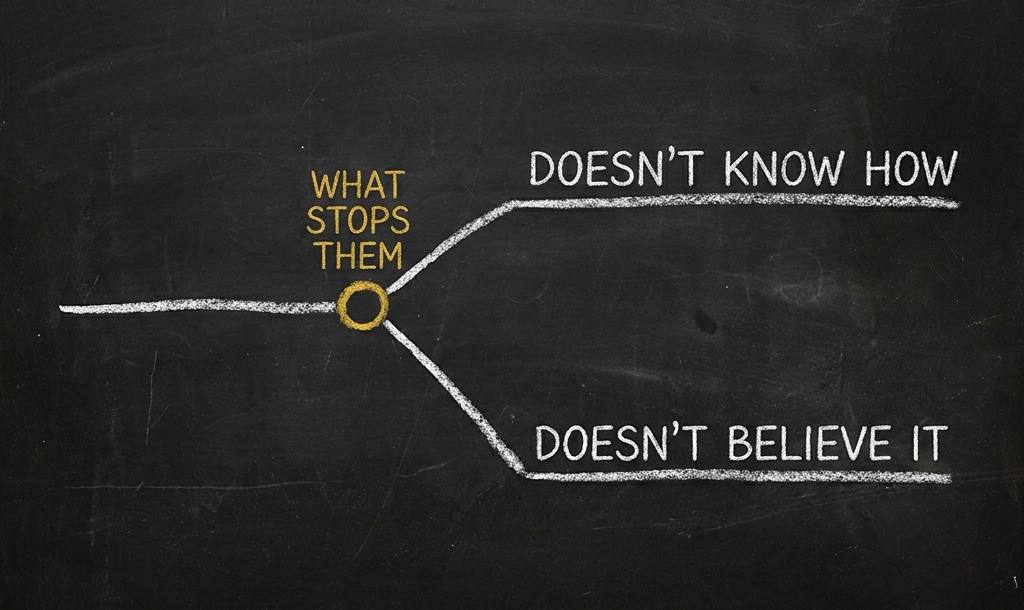
The source material is two practitioner books that genuinely disagree about what a selling presentation is for. Blending them gives you a draft with two spines pulling in opposite directions. So the first question is not which framework, it is what is stopping this buyer: they do not know how, or they do not believe it works for them.
The transition is a section, not a sentence
It is the shortest part of a presentation, the part most drafts silently omit, and the one whose real beneficiary is the presenter rather than the audience. A gate fails any draft with fewer than three transition beats, because a missing bridge is the defect that shows up most often when people drop exactly at the pitch.
Every urgency claim has to name its mechanism
The corpus teaches countdown timers, seat caps and earnings screenshots with no regulatory framing at all. It also says once, plainly, do not use scarcity if it is not true, and then never checks. A script does. Every deadline, seat cap, results screenshot and guarantee names what makes it true or the draft fails.
What the routing and the evidence bar look like

What a diagnosis actually returns
> "people watch the whole thing and nobody buys"

  SYMPTOM ..... engaged through the pitch, no purchase
  SECTION ..... (4) the close
  DEFECT ...... objections handled once, not cycled
                offer shown in pieces, never whole

  CHECK ....... verify-close-coverage.mjs
                money + time cycled ......... FAIL
                objections named ............ 4 of 9
                offer accumulated before
                  the price ................. FAIL

  FIX ......... references/the-close.md
                the last thing shown before
                the price is the COMPLETE offer,
                not the final bonus

  → one section rewritten, three left alone
That last rule is one of only two claims in the whole corpus that both books reach independently, with different vocabulary. The other is that teaching the tactics kills the sale. Those two are the only double-witnessed evidence available, so those two are the ones enforced by scripts. Everything else carries one witness and ships labelled that way.
It decides and composes. It will not host your event or fill your room.
webinars is one skill in the system behind Di-Atomic, the marketing and compliance agency that runs cognitoAI, SpiderIQ and OPVS. It refuses to proceed on an undefined offer or an undefined audience, because two of the three named causes of failure sit outside it entirely. If you want the room filled, the offer priced and the presentation built, in any of our seven languages, that is the day job.
Book a 30-min call with Di-AtomicJust want the skill? Get @di-atomic/webinars free.