
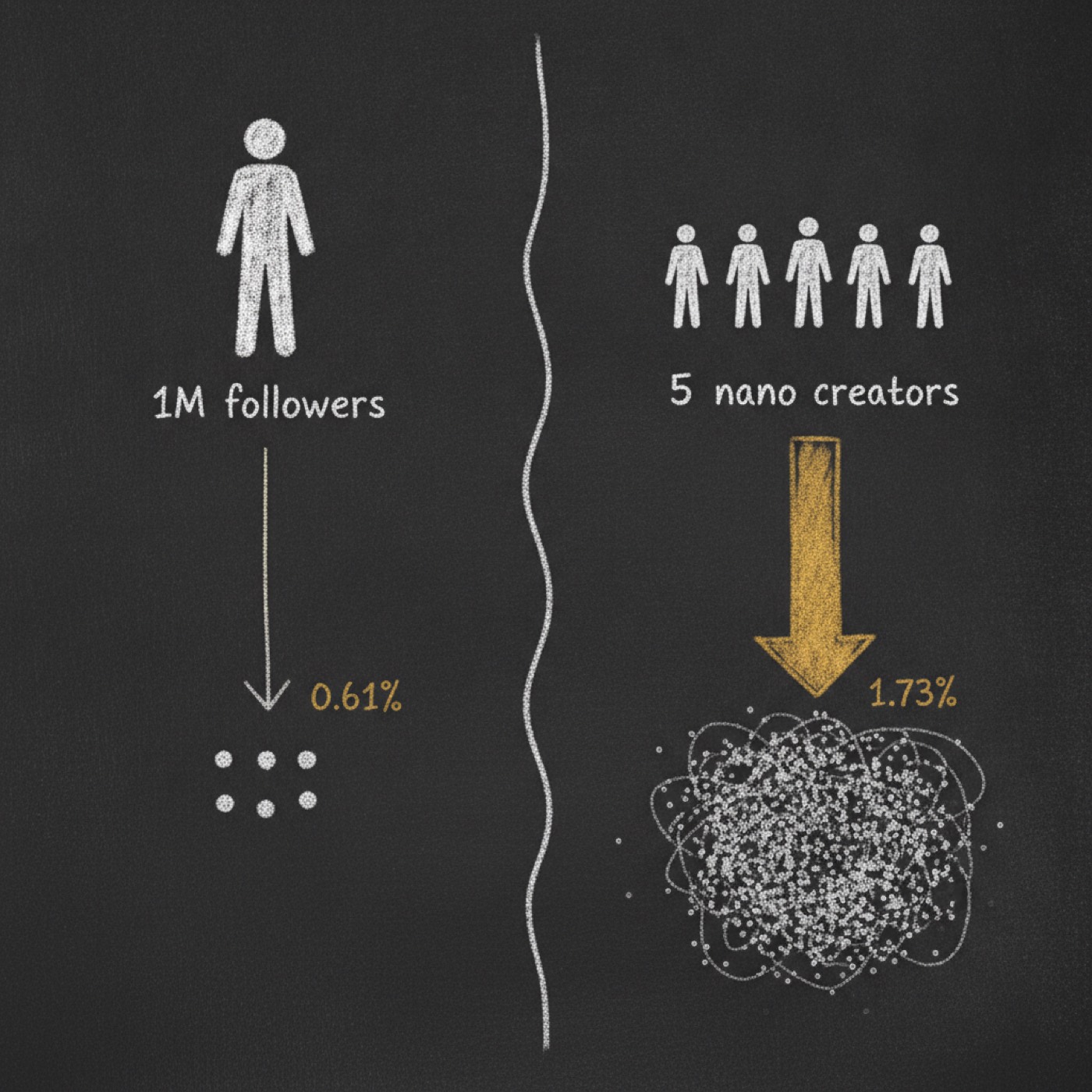
I thought follower count meant reach. Nano beat macro 3 to 1.
I spent a long time believing that a creator with a million followers was worth more than twenty creators with ten thousand. Then I went and pulled the 2024 engagement numbers for Instagram. Nano creators averaged 1.73%. Macro creators averaged 0.61%. Mega creators averaged 0.68%.
Nano beat macro by roughly three to one. On the metric that decides whether anyone actually sees the post.
That was the first of three things I got wrong about creator marketing. I built all three corrections into a skill, and each one is now enforced by a script rather than by my judgement on the day. Here is what changed.
Wrong thing #1: follower count is a proxy for reach
It is not. It is a proxy for how long the account has existed.
A million followers at 0.2% engagement reaches 2,000 people. Twenty nano creators with two thousand followers each, at 5%, reach the same 2,000. They cost a fraction, and they give you twenty pieces of content instead of one. The math is not subtle once you write it down. It just never gets written down, because follower count is the number that appears on the profile and engagement rate is the number you have to go and calculate.
So the skill calculates it, and then refuses to rank on anything else. There is an anti-vanity gate that flags any creator below a 3% engagement floor. The floor is tier-relative, because a flat number would be dishonest in the other direction: nano sits at 5 to 8%, micro at 3.5 to 6%, mid at 2 to 4%, macro at 1.5 to 2.5%, mega at 1 to 2%. A macro creator at 2% is performing normally for their tier. A nano creator at 2% is underperforming badly. One number cannot say both things, so the gate reads the tier first.
One caveat I want to be honest about, because it cuts against the headline: micro creators outperform nano by around 45% on conversion once you need scale. Nano wins on engagement rate. Micro wins on getting you enough volume to matter. If you optimise purely for the highest percentage you will end up with a beautiful spreadsheet and not enough reach to move anything.
The pattern that actually wins is a fleet. goPure ran 160 micro creators and reported 204x return. Not one perfect creator. A hundred and sixty adequate ones.
Wrong thing #2: a tighter brief produces better content
This one cost me the most, because it feels so obviously true. More direction, more control, more on-brand output. Every instinct I have as a marketer says write the better brief.
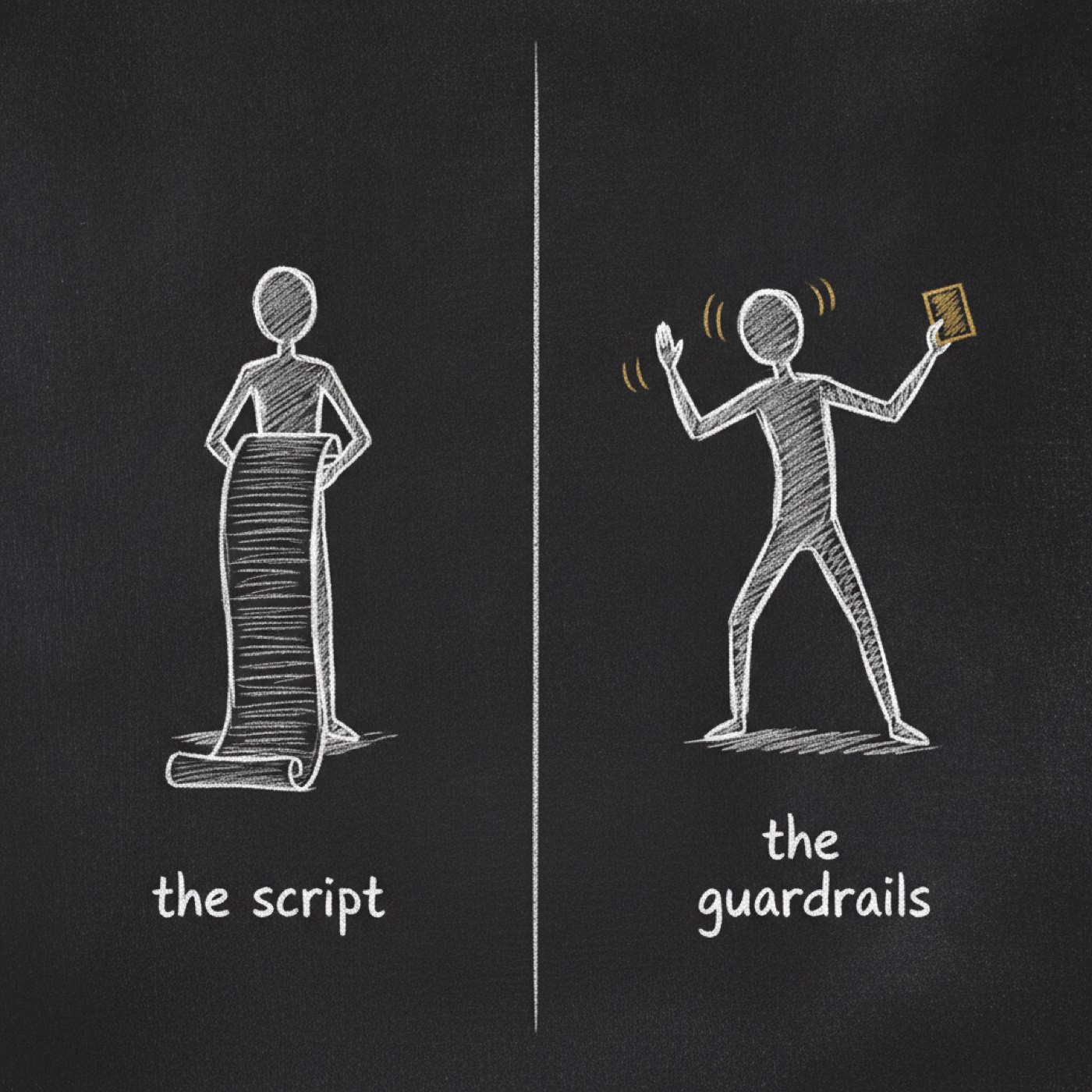
Over-scripting is the single most common reason user-generated content underperforms. When you hand a creator a script, you get a person reading a script. Their audience followed them because they do not sound like that. The thing you paid for, which is the trust between the creator and the people who watch them, is exactly the thing the script destroys.
What works is guardrails instead of a script. Give three to five hook options and let them pick. Say what must appear, what must be avoided, and what tone to hold. Give one clear call to action. Then get out of the way and let them shoot it the way they shoot everything else.
There is a second distinction underneath this that I had collapsed. A UGC brief and a sponsored-post brief are not the same document. UGC is product-centric: the creator is a storytelling instrument, the product is the subject, the output is usually recycled into ads. A sponsored post is creator-brand-centric: their voice is the point, their audience is the buy, and the approval workflow is heavier because their name is on it. Use the wrong template and you get off-brief content that nobody can quite explain the problem with.
While we are on briefs: every one of them carries a disclosure clause, and that is not a style preference. FTC 16 CFR 255, the ASA guidance in the UK, and the DSA in the EU all treat any material connection as disclosable. Cash, gifting, affiliate commission, free product, perks. All of it. Calling something thought leadership does not exempt it. The disclosure has to be obvious to an average viewer immediately, at the top of the caption or in the first frame, not buried in a bio. A script checks for it, because this is legal liability and I do not want it depending on whether anyone remembered.
Wrong thing #3: the campaign result is the campaign result
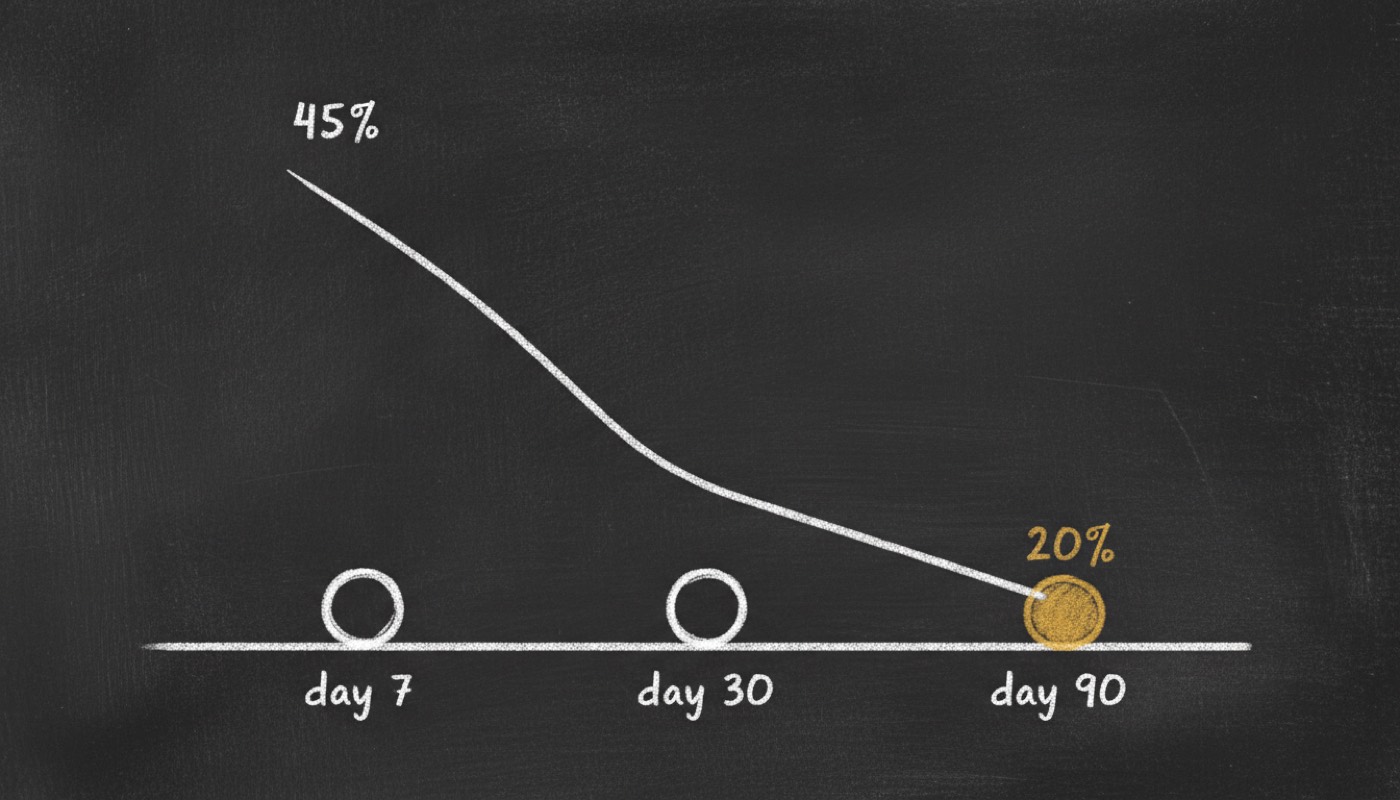
Dunkin ran a campaign with Charli D'Amelio that showed a 45% lift on launch day. The sustained figure was 20%.
Both numbers are real. Only one of them is the answer. And the industry has quietly standardised on reporting the launch-day one, because it is the number that makes everybody look good in the recap deck.
So measurement in this skill happens three times: at 7 days, at 30 days, and at 90 days. The 7-day number tells you the content landed. The 30-day number gives you real return on ad spend and cost per acquisition. The 90-day number tells you whether you bought customers or bought a spike. That last one is the honest one, and it is the one almost nobody waits for.
What the numbers look like when you get all three right
A gift-seeding funnel I studied sent 3,200 offers, activated 429 creators, and produced 5.9 million views at a $1.90 CPM. Paid social runs $8 to $35. That is not a marginal improvement, and the campaign also left behind a library of content to recycle into ads.
That result is not available to you if you rank on followers, script the creators, and report the 7-day number. All three corrections have to hold at once.
How it runs
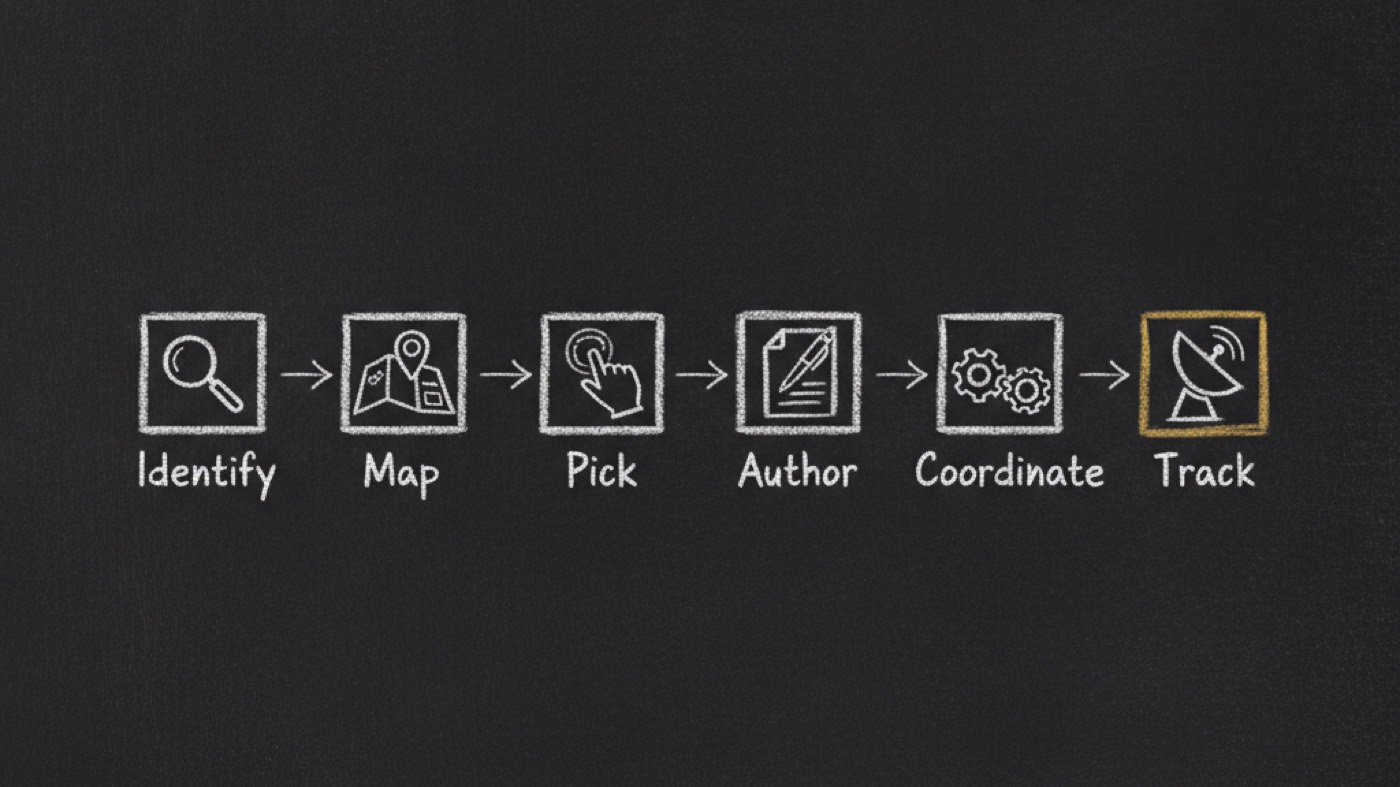
The loop is called IMPACT. Identify the audience and recall what worked before. Map creators across the platforms that actually matter for your language and region. Pick on fit score. Author the brief. Coordinate outreach through to contract. Track real return.
The skill is guidance-only, which means it does not execute anything itself. It runs on the stack I already own. Discovery goes through scrapecreators-api. Outreach drafts in outbound-engine and sends through smartlead. Briefs are written by copy-engine, voiced by voice-builder, opened by hook-generator. Every creator becomes a deal card on AgentBoard, moving through discovered, pitched, negotiating, contracted, content-due, published, measured. AgentMemory remembers which creators worked so the next campaign starts smarter than the last one.
It is not a wrapper around Aspire, Modash, GRIN or Upfluence. There is no subscription underneath it. That was the point.
One practical note if you run it: the audience-demographics call costs 26 credits, and most other calls cost one. So run cheap discovery across the whole longlist, then pull real demographics only on the three to ten creators you actually shortlist. A 50-creator campaign lands around 330 credits. Pull demographics on everyone and you will burn your balance before you have picked anybody.
Live on the OPVS marketplace as @di-atomic/influencer-marketing.