
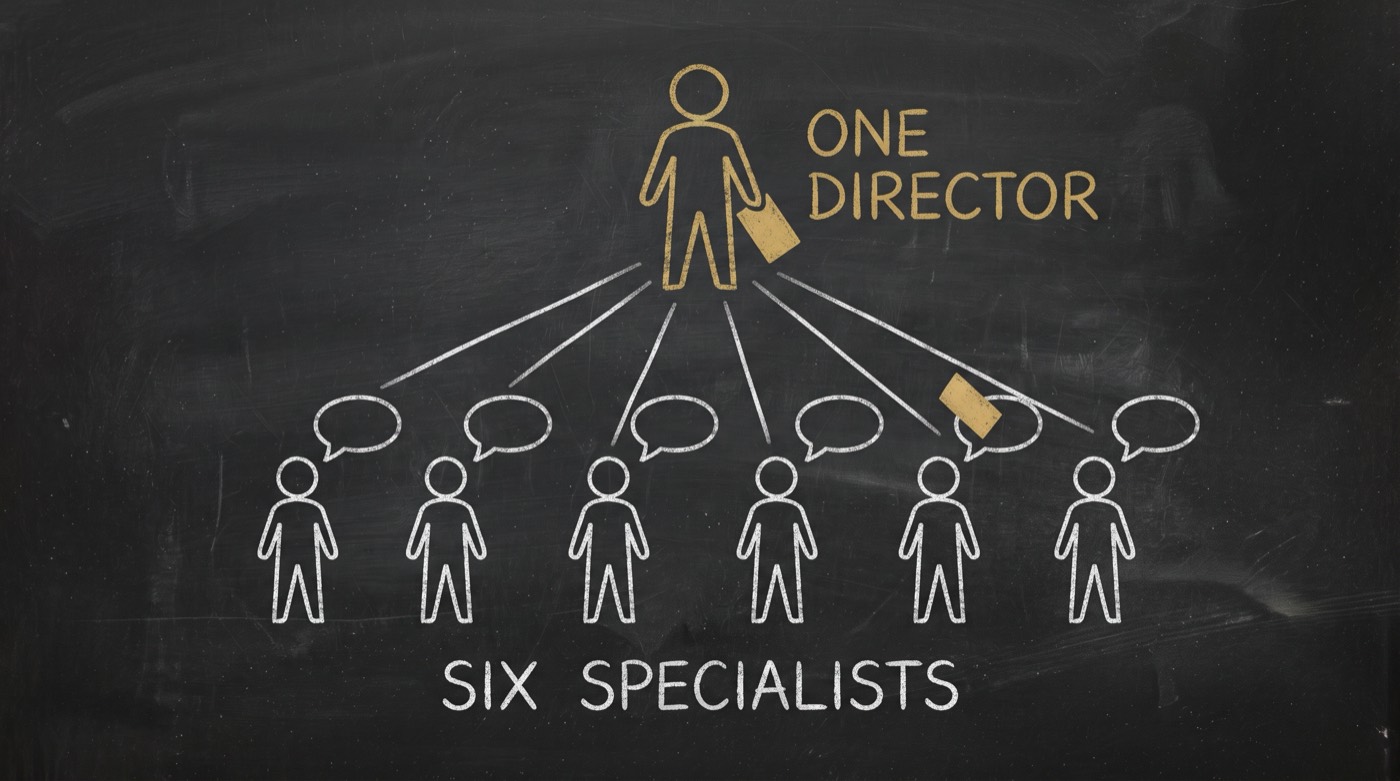
Six social specialists is not a team. Here's your director.
I shipped six social specialists this year. LinkedIn, X, Instagram, Facebook, YouTube, Threads — each one a real role with its own craft, its own platform rules, its own opinion about what good looks like.
Then I equipped all six on one brand and watched what happened.
Nothing happened. Six agents sat there, each waiting to be told what to do, by me. I had replaced one writing job with six briefing jobs. The sixth specialist made the product worse than the third, because every one I added was another brief I owed on Monday morning.
That is the problem this role fixes. In this post I'll show you what a Social Media Director actually does, the seven skills it reads and calls, the five workflows it runs, and the one thing it flatly refuses to do.
Six listings is not a team
The catalogue lies to you a little. It shows you six capable roles and lets you assume that equipping all six gives you a department. It doesn't. It gives you six queues and a single point of coordination, which is you.
A real department has something the catalogue never sold you: the person who takes one intent — "we're launching the new pricing on the 14th" — and turns it into briefed, sequenced, owned work. Nobody in the room writes that brief for themselves. Somebody writes it for everyone.
That job has a name in every agency I've ever worked with, and it isn't "manager." A manager runs a channel. A Director runs the department. That's the level this role sits at, and it's why it's the twelfth profession I've shipped but the first one that coordinates other professions instead of surfaces.
What you hire when you equip it
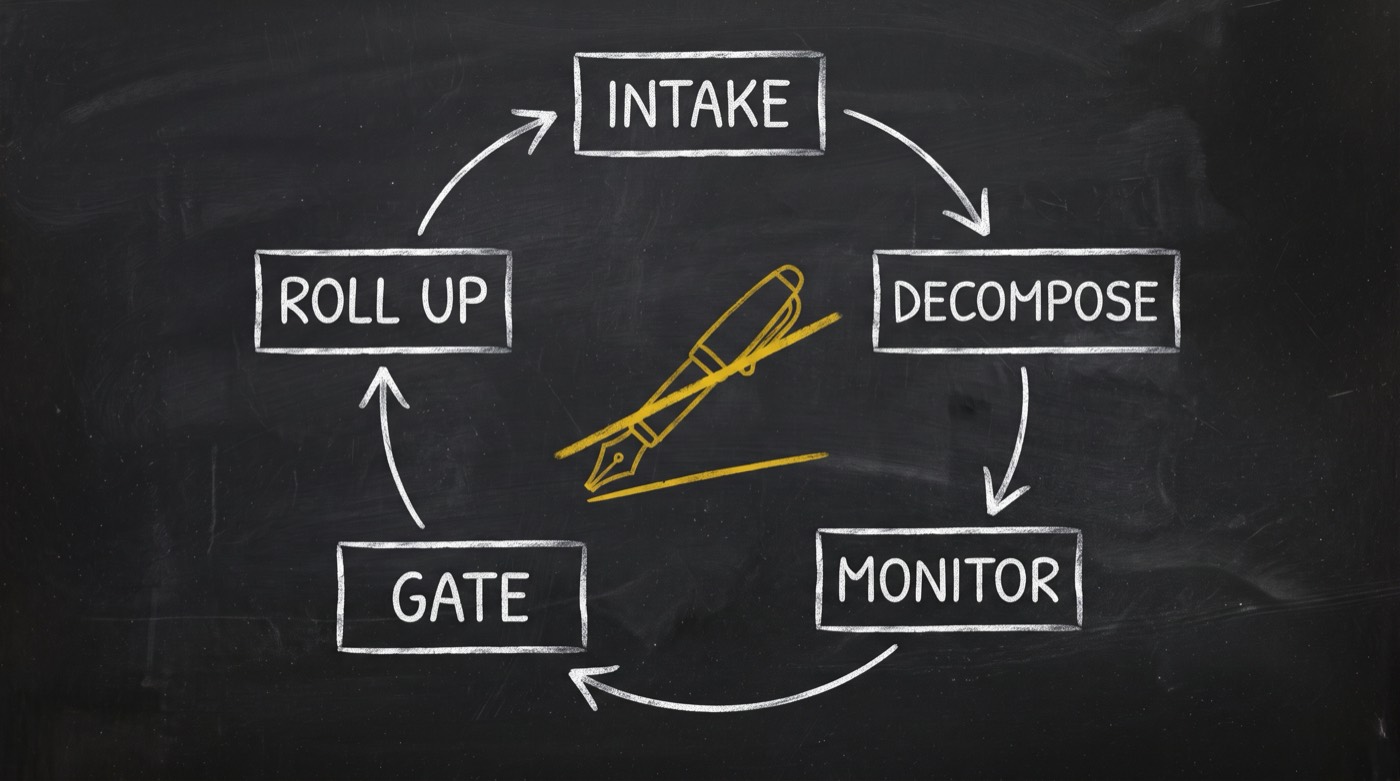
Five moves, in order: intake → decompose → monitor → gate → roll up.
Intake happens once. Your voice profile, your pillars and your exclusions, your cadence targets, your named approver, your compliance class, your publishing owner — and the input every manager is tempted to skip, the roster of specialists you actually have equipped. It ends in a record, not a plan.
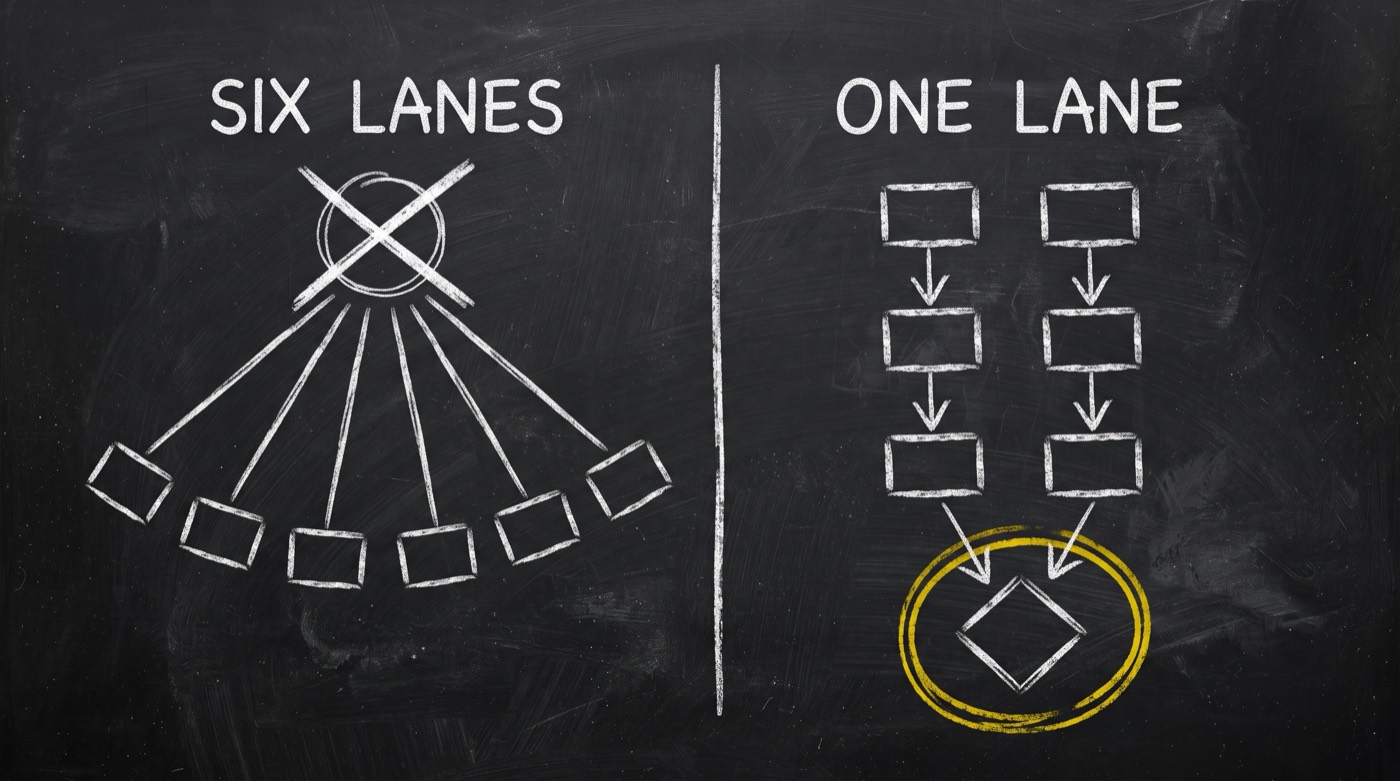
Decompose is the craft. One intent goes in. Out comes a calendar of slots, a deliberately shaped dependency graph, and one briefed card per slot — cards your specialists claim with nobody assigning them. Not six cards hanging off one hub, either. That shape is a bottleneck with a nice diagram: when the hub stalls, six lanes stall and your whole week is hostage to one card. The Director layers it into waves with a convergence node, so a stall costs one lane.
Monitor watches the graph, not the workers. Gate grades what comes back against the brief as it was given — brief-match, voice, compliance, vanity. Roll up pairs every success claim with a real outcome metric, or an explicit UNKNOWN.
Then the refusal, which is the whole design:
It does not write the post.
Not the caption, not the thread, not the hook line, not "just this one because the slot is today." When a draft fails the gate it comes back naming the gate and the clause it missed, carrying no rewrite. Fixing the line yourself is faster. That's exactly why it's refused. Do it once and three things break at once: your specialist stops being accountable for its own output, your gate stops generating data about which briefs are weak, and your Director becomes the bottleneck you hired it to remove.
You didn't buy a writer with extra steps. You bought the thing that makes six writers work without six briefing meetings.
The toolkit — seven skills
Four it calls, three it reads. The split matters: reading is craft, calling is machinery.
@opvs-ai/agentboard— the mechanism. Lays the whole DAG in one batch call, proves the frontier is visible, watches what advanced.@opvs-ai/agentdocs— the intake record. Re-read at every decomposition, never recalled from memory.@opvs-ai/agentmemory— the performance loop. Which angle, format, cadence and hour won for your brand.@opvs-ai/opvs-protocol— the guild address and the escalation path.@di-atomic/social-media-manager— the methodology library: cadence bands, pillars, the review gate. Read, never called.@di-atomic/hook-generator— the campaign angle only, never a finished line. The narrowest possible use of a link, and the narrowness is the point.@di-atomic/voice-builder— the voice profile the gate grades against. Without it the gate has no baseline.

The five workflows
Each one is forked per brand, never reshaped in place.
Workflow | Fires when |
|---|---|
| before any campaign — blocking |
| a campaign intent arrives |
| work is in flight |
| a runnable card sits unclaimed too long |
| end of the cycle |
The guild address
Every profession I ship has one. This role's is:
social-media-director@profession.mdThat address isn't decoration — it's how the craft compounds. Directors pull the profession's published craft, contribute anonymized learnings back, and the library gets better for everyone at the address:
opvs profession pull social-media-director
opvs profession contribute social-media-director
Cycle seven should be cheaper than cycle one. The address is why.
What I can and can't prove yet
Here's the part most launch posts skip.
This role rests on the AgentBoard claim loop — cards created by one agent, claimed by another with no human in between. Every primitive existed. Nothing in my stack had ever run the whole loop end to end. So before publishing, I walked it on a throwaway board: five cards laid in one batch call with zero errors, a task claimed with no human assigning it, an artifact handed back, and the frontier advancing from one runnable card to two with the convergence node correctly still blocked.
The loop closes. It also taught me something that changed the bundle: a batch-created card ships with no stage, and the hand-back call requires one — so the specialist had nowhere to put its work. That's now an explicit step.
What that walk did not cover: it ran on one credential. So the actor gate and the concurrent claim lock are still unexercised, and a board is inert until something is actually listening to it. I'd rather tell you that than report a green board.
Equip it
opvs tools install @di-atomic/social-media-directorThen give it thirty days. Week one is intake — expect it to ask for the roster and the approver before it will decompose anything, and expect that to feel slow. Weeks two and three, watch two numbers that are already on your board and nowhere else: follow-up questions per brief, and rework rate after the gate. Both should fall. That's the only honest read on whether the decomposition is any good, because this role produces almost no prose of its own.
By week four you should be handing it an intent instead of a brief.
You already had the specialists. This is the part that makes them a team.